Free Template · from the makers of NominalQC, QC software for small manufacturers
Free ISO 9001:2026 gap analysis template for Excel
Your certificate to the 2015 edition stops being valid in September 2029, and most shops have not started. This workbook walks all 53 requirements of the 2026 edition as plain-English questions, flags every clause that changed, turns your shortfalls into an owned action plan on its own, and scores how ready you are. Written from the published standard — which is also how it can tell you, with receipts, that the AI and cybersecurity requirements you have been warned about are not in it.
Related: Internal audit checklist · Document register · Process turtle diagram
Free Excel template — no email, no signup.
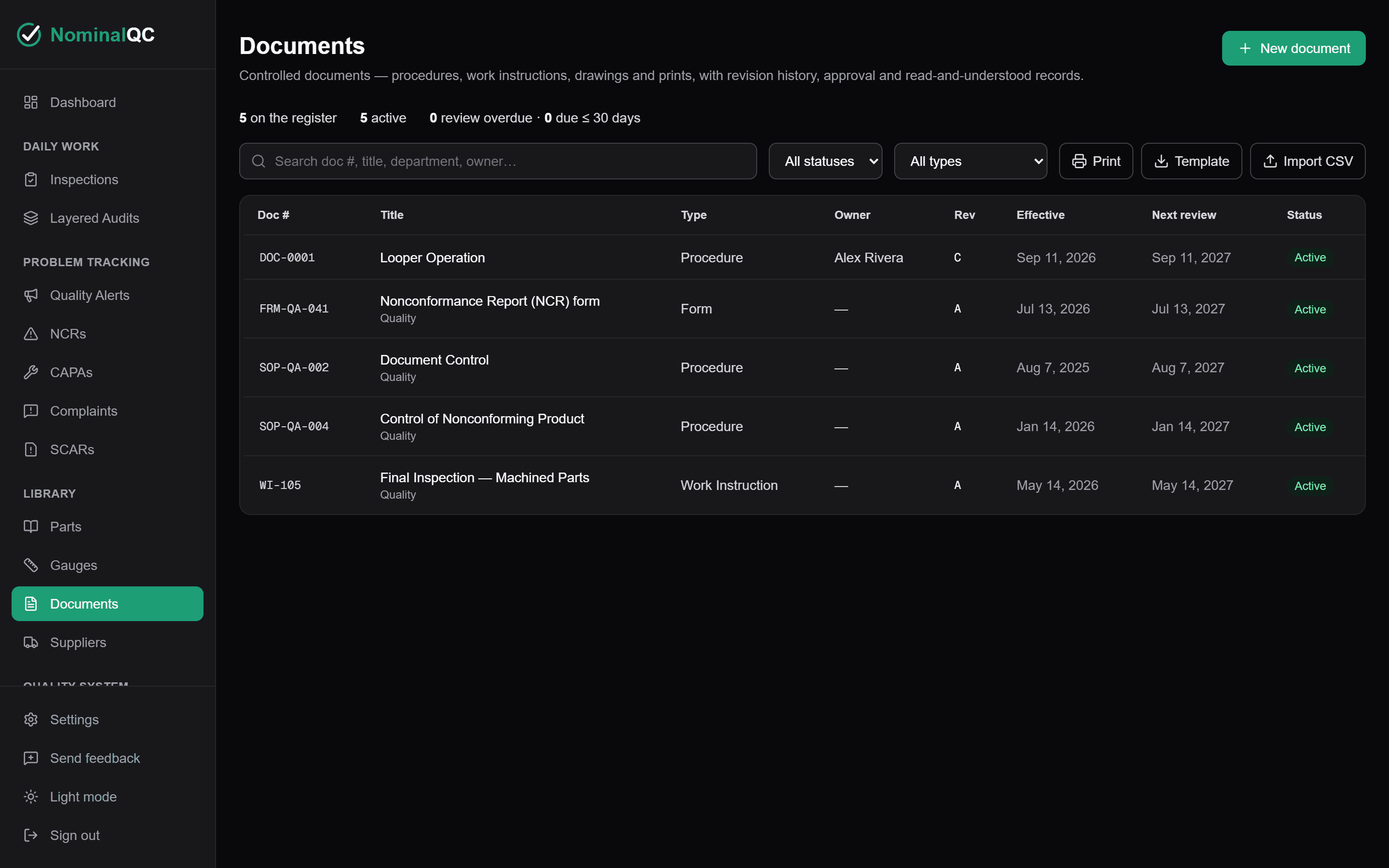
This log, without the spreadsheet
The clauses this workbook says you are short on — context and interested parties, risks and opportunities kept separable, the management review inputs that changed — are registers in NominalQC, each one citing the clause it answers to.
Try the live demoOpens on the real app with seeded data · no signup, no email · read-only · free for one user when you’re ready.
Prefer it in your inbox, with two short notes on using it?
What’s in the download
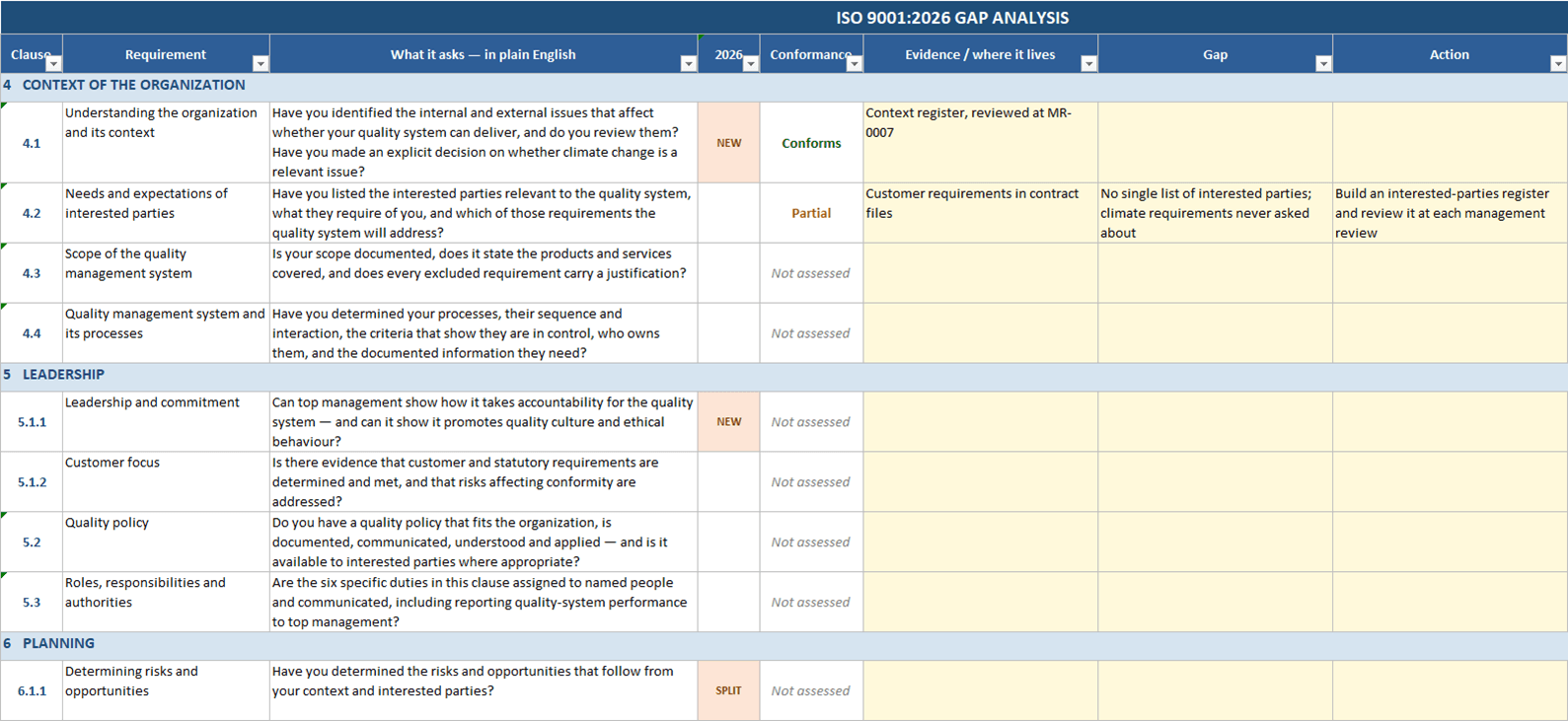
- GAP ANALYSIS: all 53 requirements of ISO 9001:2026 clauses 4 to 10, each written as a plain-English question you can answer without the standard open in front of you
- Every clause the 2026 edition changed is flagged NEW, CHANGED, SPLIT, MOVED or WORDING — filter on that column and you have your transition scope in one screen
- Conformance dropdown (conforms / partial / does not conform / not applicable / not assessed) with colour coding, plus evidence, gap, action, owner, priority, due date and status columns
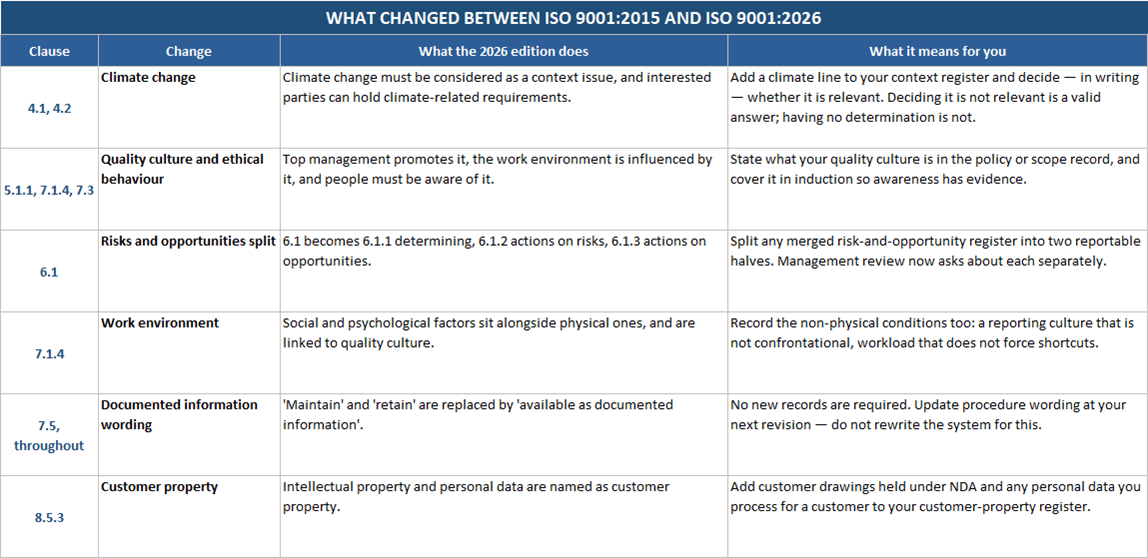
- WHAT CHANGED: the ten real differences between the 2015 and 2026 editions, what each one does, and what it means for your paperwork
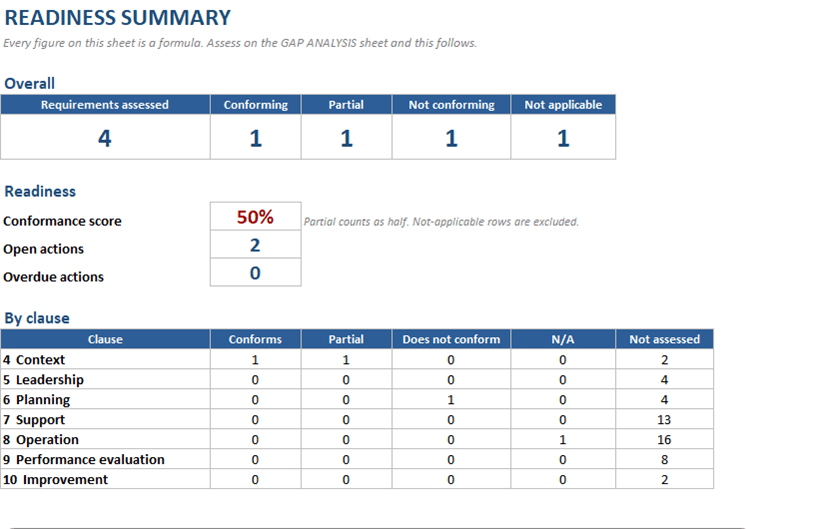
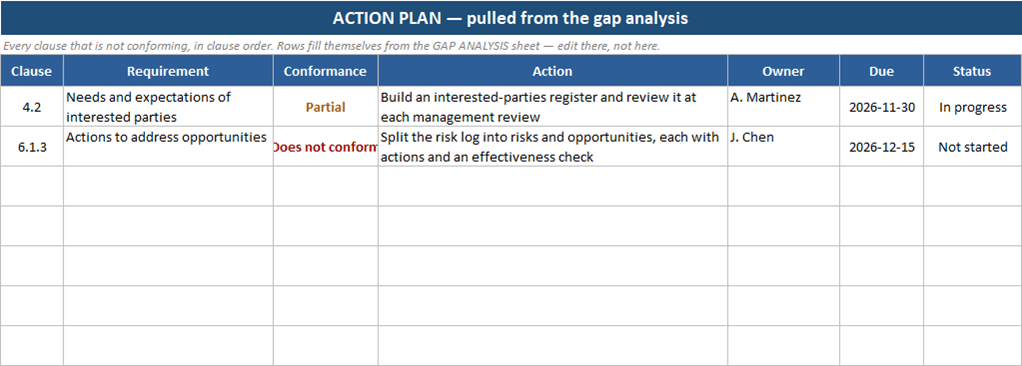
- ACTION PLAN: every partial and non-conforming clause, with owner and due date, pulled across automatically — overdue dates turn red on their own
- SUMMARY: conformance counts, a readiness score that discounts partials by half and excludes not-applicable clauses, open and overdue action counts, and a stacked chart by clause
- Sample entries on the first rows showing what a real assessment looks like, including a justified 8.3 exclusion for a build-to-print shop
- 100% macro-free — no "Enable Content" prompt. Excel 2010+ on Windows and Mac, and it opens in LibreOffice and Google Sheets
You get the Excel workbook (.xlsx) and a one-page start-here guide. Requirements are paraphrased as questions — ISO 9001:2026 is copyrighted, so no clause text is reproduced. You still need a licensed copy of the standard; this tells you where to look in it.
Where this spreadsheet breaks
A gap analysis tells you what is missing. Keeping it true for the three years until your transition audit is the part a spreadsheet cannot do:
1.The assessment is accurate for about a week
You fill it in over two evenings, close 20 gaps over six months, and nobody reopens the file. At the transition audit it describes a quality system that has moved on without it.
In NominalQC the clauses are live registers rather than a snapshot: context issues, interested parties, risks and opportunities, processes and objectives each carry an owner and a review date, and the ones coming due surface on the dashboard.
2.The actions have owners in a column and nowhere else
A due date in a spreadsheet nobody opens is not a plan. The gaps that get closed are the ones somebody remembers, which are rarely the ones that matter most.
Actions in NominalQC are records: assignment emails the owner, due items appear on their dashboard, and the weekly digest lists what is overdue — so a missed date is visible before the audit finds it.
3.The 2026 management review inputs quietly go missing
Clause 9.3.2 gained a required input and split risks from opportunities. A review held to the 2015 agenda is missing a required input, and a minute taken in a Word file will not tell you that.
The management review in NominalQC is built to the 2026 text — all fourteen inputs are required before a review can be completed, each labelled with its own letter, and risks and opportunities are reported separately.
Who built this
I spent 16 years in manufacturing quality — machining, fabrication, assembly — and in every shop I ended up building the same Excel tools with macros because the software budget went elsewhere. These workbooks are the ones I kept rebuilding. Eventually I stopped rebuilding spreadsheets and built NominalQC instead — but the spreadsheet is still the right starting point for a lot of shops, so here they are, cleaned up and free.
Questions
Is it really free?
Yes. You get the full workbook and the setup guide in exchange for an email address. Two short follow-up emails about running the process, then silence — unsubscribe anytime.
Does it work on Mac or older Excel?
Yes — this workbook is 100% macro-free, so there’s no "Enable Content" prompt and it works in Excel 2010 or later on Windows and Mac.
When do I actually have to be on the 2026 edition?
September 2029. Certificates issued to ISO 9001:2015 stop being valid at the end of the transition period, and your registrar will want to see a transition plan well before that — in practice at your surveillance audit in 2027 or 2028. A completed gap analysis is the document they ask for first, which is why this workbook exists.
Does ISO 9001:2026 add AI and cybersecurity requirements?
No. The terms "artificial intelligence", "cyber" and "data integrity" appear zero times in the published standard. That claim circulates because it sells transition courses. What the 2026 edition actually added is climate change as a context consideration (4.1 and 4.2), quality culture and ethical behaviour (5.1.1, 7.1.4, 7.3), a split of risks and opportunities into separate clauses (6.1.2 and 6.1.3), personal data and intellectual property named as customer property (8.5.3), and a changed set of management review inputs (9.3.2). All ten changes are on the WHAT CHANGED sheet.
How much of my 2015 system has to change?
Less than you have been told. The clause structure is unchanged, clause 8 is barely touched, and the maintain / retain wording change needs no new records at all — update it at your next revision. The work is concentrated in four places: a climate determination in your context register, a risk register that keeps opportunities separable, an awareness and culture statement, and a new management review agenda. Filter the 2026 column in the workbook and those are the rows you get.
Is this a checklist I can hand to an auditor?
It is a self-assessment, and that is exactly what a registrar asks to see when you say you have started transitioning. It is not a certification audit and it is not a substitute for the standard — the questions are our plain-English paraphrase, because the text itself is copyrighted.
Does it cover IATF 16949 or AS9100 as well?
Not directly. The 53 rows are ISO 9001:2026 only. Both of the others are built on the ISO 9001 clause structure, so this covers the base layer for either — you would add the IATF or AS9100 specific requirements as extra rows. The internal audit checklist template covers more of that ground.
More free templates
Ready to skip the spreadsheet stage?
Inspections, NCRs, CAPAs, LPAs, and gauge calibration — free for one user, team plans from $59/month flat.
Create your free account